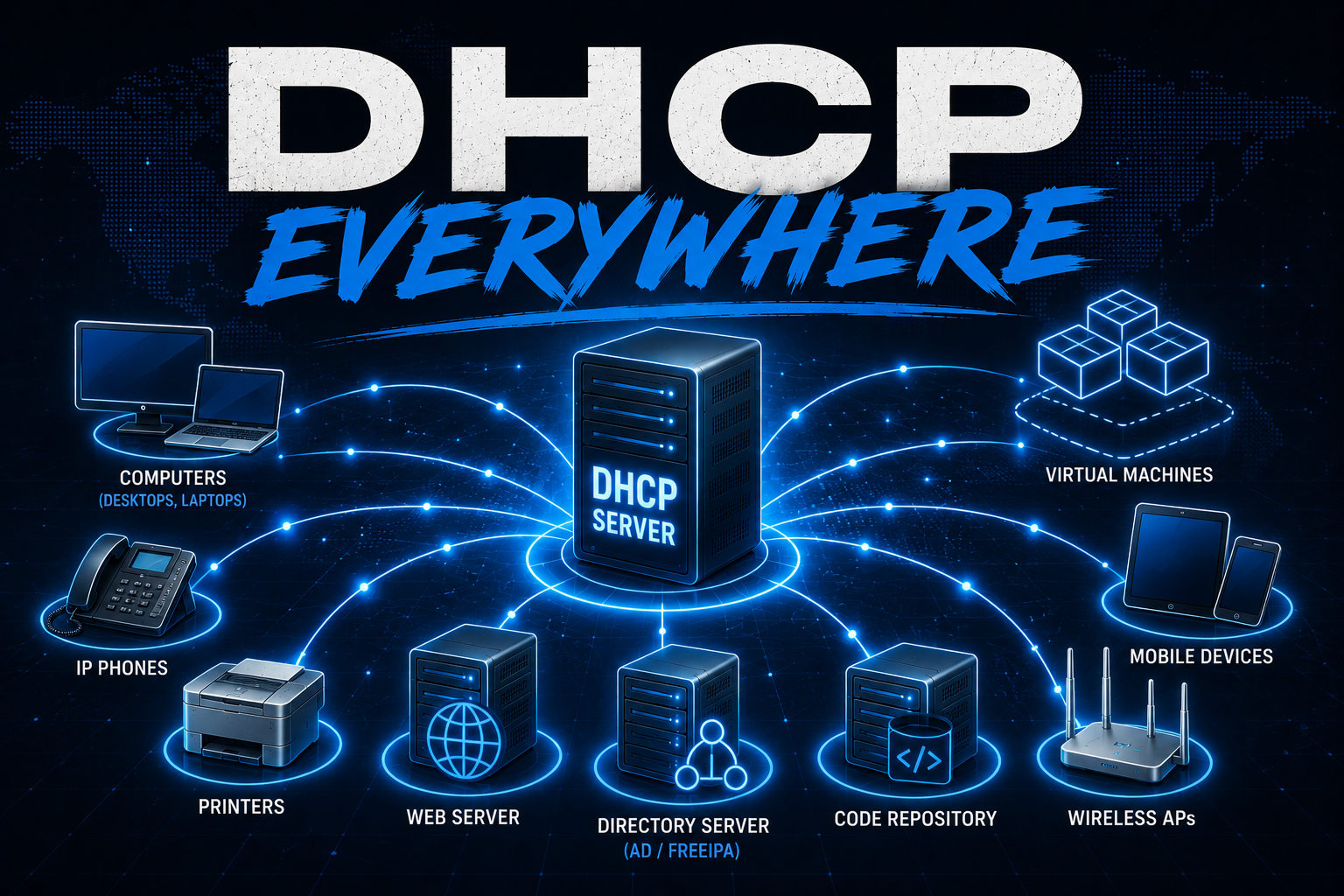
The Argument for DHCP Everywhere
Published June 13, 2026, 7:56 p.m. by dwest
Introduction
One of the most persistent beliefs in IT is that critical infrastructure should always use static IP addresses. Ask a room full of system administrators how to configure a domain controller, database server, hypervisor, or monitoring system and many will immediately respond:
“Servers should always have static IP addresses.”
I’ve spent most of my career following that advice, maintaining spreadsheets, IPAM systems, network diagrams, and documentation in an attempt to keep static assignments organized. Yet despite all of that effort, one problem continued to surface over and over again:
IP conflicts.
Eventually I started asking a different question. If DHCP already solves address allocation, conflict detection, ownership tracking, and change management, why are we bypassing it for the systems we care about most?
The answer is that many organizations are confusing static addresses with stable addresses. They are not the same thing.
The Real Problem: Ownership
An IP address is only useful if you can answer one simple question:
“Who owns this address?”
In a static environment the answer is often surprisingly difficult.
- A spreadsheet says one thing
- A wiki says another
- The original administrator left years ago
- The server was rebuilt
- The documentation was never updated
Eventually someone reuses an address and a conflict appears.
Static addressing does not solve ownership. It merely distributes ownership information across documentation, institutional knowledge, and individual systems.
Why Static IP Conflicts Are So Painful
When two statically configured systems use the same address, the symptoms are often bizarre:
- Intermittent connectivity
- Random authentication failures
- ARP table instability
- DNS inconsistencies
- Services working from some systems but not others
Finding the source often requires:
- Examining ARP tables
- Searching switch MAC address tables
- Running packet captures
- Tracking down physical devices
- Remote hands support
The problem is entirely client controlled.
The network has no authoritative record of who should own the address.
What DHCP Actually Provides
Most administrators think of DHCP as a convenience feature for laptops and desktops.
In reality DHCP provides:
- Centralized address allocation
- Lease tracking
- Ownership history
- Conflict detection
- Reservation management
- Auditing
The DHCP server knows:
- Which MAC address owns an IP
- When it was assigned
- When it expires
- Whether a conflict occurred
- Whether a client rejected the assignment
That information simply does not exist in traditional static environments.
Static Addresses vs DHCP Reservations
This is where many discussions go off the rails.
The choice is not:
- Static IP
- Dynamic IP
The choice is usually:
- Static IP
- DHCP Reservation
With a reservation:
- The host always receives the same address
- DNS records remain stable
- Firewall rules remain valid
- Monitoring remains unchanged
From the server’s perspective the address never changes.
From the administrator’s perspective ownership is centrally managed.
You get the benefits of static addressing without the operational burden.
The Common Objections
“What if DHCP goes down?”
A valid concern, but modern DHCP deployments are typically redundant.
Additionally:
- Existing clients keep their leases
- Renewals occur long before expiration
- Most outages are resolved long before lease expiration becomes an issue
A DHCP outage is rarely as catastrophic as many imagine.
“Critical infrastructure should never depend on DHCP”
The better question is:
Why should critical infrastructure depend on spreadsheets?
DHCP failover is usually more reliable than human documentation processes.
“It’s how we’ve always done it”
Many operational practices exist because they solved problems that were common twenty years ago.
Modern environments emphasize automation, central management, and authoritative data sources.
IP management should be no different.
Where Static Addressing Still Makes Sense
There are still some systems that benefit from true static addressing:
- DHCP servers - It gets weird if you try to send DHCP messages to yourself
- Core routers - Most of the time, their interfaces are the default gateways of subnets
- Internet edge firewalls - Business ISP’s usually require that you manage your own WAN configuration
- Out-of-band management networks - These usually do not have access to DHCP servers and are often used when services are down.
- Initial provisioning environments - Any systems the DHCP servers require to be functional before their services start. This usually includes networking infrastructure and DNS at a minimum.
These systems often participate in the bootstrap process and may need to function when core services are unavailable.
A Practical Compromise
The approach I have increasingly adopted is:
Static:
- Core network infrastructure
- DHCP servers
- Management networks
DHCP Reservations:
- Linux servers
- Windows servers
- Hypervisors
- Appliances
- Virtual machines
Dynamic DHCP:
- End-user devices
- Temporary systems
- Lab environments
This provides stable addresses where needed while maintaining centralized ownership and management.
Conclusion
The goal is not to eliminate static addresses.
The goal is to eliminate unmanaged addresses.
For most servers, DHCP reservations provide the same operational stability as static addressing while adding visibility, auditing, conflict detection, and centralized control.
When viewed through that lens, the question is no longer:
“Why would I use DHCP for servers?”
Instead, it becomes:
“Why am I manually managing addresses that DHCP is already capable of managing for me?”
| Authors Note: |
|---|
| Prior to writing this article, I spent several hours investigating a DHCP pool exhaustion issue only to discover DHCP was actually protecting me from a network conflict. It knew more about the state of my network than any spreadsheet ever could. |
Similar posts
There are no similar posts yet.0 comments
There are no comments.